Editor’s note: This article is adapted from Pastor Steven Lee’s message, “A Legacy of Serious Joy,” along with family history and historical materials he shared with ChinaSource. It has been edited for publication with his review.
Two years ago, Pastor Steven Lee found himself standing in a place he had only recently learned was connected to his own family story.
He had been invited to speak at a pastors’ conference at the school Robert A. Jaffray established in Makassar, Indonesia. The school still sits at its original location.1 For many attending, Jaffray’s name belonged to mission history. For Lee, however, the connection had become deeply personal.
Jaffray was not only a well-known Canadian missionary strategist who served in South China and later helped open gospel work in Southeast Asia. He was also, as Lee learned in college, connected to the conversion of his great-grandfather in Wuzhou, Guangxi.
“I am a fourth-generation Christian,” Lee reflected in his message. “My great-grandfather, grandfather, and father served as pastors at various points in their lives. And in college I learned that my great-grandfather was a convert of Robert A. Jaffray.”
The story that follows is not simply about a Western missionary who went to China. It is also about a Chinese man whose life was transformed by the gospel, the local church leadership that emerged in Guangxi, and a faith that continued across generations—from South China to Hong Kong, from Indonesia to North America.
A Life That Did Not Take the Return Ticket
Robert Alexander Jaffray was born in Toronto in 1873 to Scottish immigrant parents. His mother was a devout Christian; his father was a successful businessman who eventually gained a controlling stake in The Toronto Globe, one of the city’s leading newspapers.
From the outside, Jaffray did not look like an obvious candidate for a lifetime of cross-cultural gospel work. He suffered from heart disease and diabetes. A. W. Tozer, in his biography of Jaffray, described him as an “overly stout boy.”2 Yet at age sixteen, Jaffray came to faith through the ministry of his Sunday school teacher. At twenty, after hearing A. B. Simpson preach, he became convinced that God was calling him to overseas mission work.
His father had other plans. He wanted his son to take over the newspaper business. According to Tozer’s account, Jaffray’s father told him that if the Alliance sent him to China, they could pay his expenses. He would not give him a dime. But if Jaffray later decided the whole thing had been a mistake and wanted to come home, his father would send money for the return trip.3 Jaffray never used that return ticket.
In 1897, he was among the first group of Christian and Missionary Alliance missionaries ordained in Canada. Soon after, he left for South China. Wuzhou, in Guangxi, would become the center of his ministry for the next thirty-five years.
There, Jaffray became known not only as a preacher, but as a strategist and institution-builder. He helped establish a Bible school, taught regularly, and founded the South China Alliance Press. As students graduated and went out into gospel work, Jaffray began writing letters to support and encourage them. These letters eventually developed into the Chinese-language Bible Magazine, which served local Christians.
Jaffray’s ministry in Wuzhou was never meant to end with himself. Schools, publications, churches, and local workers were all part of a larger vision: the gospel taking root in local soil, carried forward by Chinese believers.
A Shoe Merchant in Wuzhou
Among those whose lives were changed in Wuzhou was Lee’s great-grandfather, Li Jiupu.
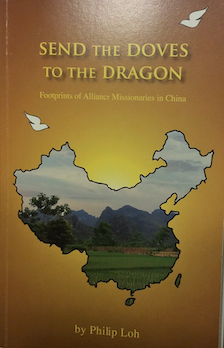
According to family history and the account preserved in Send the Doves to the Dragon by Philip Loh, Li was originally from Guangdong and had gone to Guangxi to make a living. He was a shoe businessman who once operated three stores in the city. But he developed an addiction to opium and lost his businesses.
The story could have ended there—with financial ruin, addiction, and obscurity.
Instead, in 1905, at the age of thirty-six, Li stumbled into a gospel center on Sifang Street in Wuzhou. There he heard the good news of Jesus Christ. Moved by the Holy Spirit, he repented, followed Christ, and was baptized in the Fu River.
The change was not merely outward. As Li continued attending church meetings, he grew in his understanding of Scripture and often prayed through the night. He was also freed from his opium addiction, something the account in Send the Doves to the Dragon describes as “clearly a miracle from God.”4
For Lee, this is where broad mission history becomes family history.
His great-grandfather was not an abstract convert in a mission report. He was a man whose life had collapsed under the weight of addiction and loss. Through the witness of the gospel in Wuzhou, he was brought to faith and given a new life.
From Convert to Local Pastor
Li Jiupu later became one of the early students of the Alliance Bible School. The account in Send the Doves to the Dragon describes how he came to the school with his seven-year-old son, Li Tianren. Robert Jaffray arranged for them to sit on a bench behind a desk, with brush, ink, and paper, studying the Bible each day.
Li also practiced preaching evangelistic sermons in the evenings. He would share his conversion testimony, weaving it together with classical Chinese stories and proclaiming God’s salvation. His talks drew listeners, and the number of believers gradually increased.
After three years of study, Li entered ministry. Before there were formal graduation diplomas, he preached in different locations under arrangements with several churches. Later, as evangelistic work in Guangxi grew, more churches and gospel centers were established in places such as Pingnan and Guiping.
In 1913, Li was ordained, becoming the first ordained minister in Guangxi. It is clear that Li became an important early local pastor in the Guangxi church.
This matters.
The story of Christianity in China is often told through the names of foreign missionaries. Their sacrifice and faithfulness should not be forgotten. But neither should the Chinese believers who received the gospel, embodied it, and carried it forward in their own communities.
Li Jiupu was not merely the fruit of Jaffray’s ministry. He became a gospel worker himself. He preached, taught, coordinated ministry, and served local congregations. During one period, the work of the church included both preaching and educational ministries, with dozens of churches and gospel centers scattered across Guangxi. Lee’s manuscript notes that Li and his fellow workers helped start about fifty churches and gospel centers in the region.5
Here the legacy of Jaffray’s work became local. The gospel did not remain in the hands of the missionary. It took root in a Chinese life, then in a Chinese family, and then in Chinese churches.
A Family of Gospel Workers
Li Jiupu’s two sons followed him into ministry.
His older son, Li Tianren, graduated from the Alliance Bible School in 1919. He served at the Wuzhou Church, taught at the Alliance Elementary School and the Alliance Bible School, and later served in several churches in Guangdong, Guangxi, and Hong Kong.
His younger son, Li Chaoran, graduated from the Alliance Bible School in 1934. According to the account Steven Lee received, Li Chaoran served for thirty-six years in Guangxi, Guangdong, and later Hong Kong, including work in churches and parachurch organizations.
Li Chaoran was his paternal grandfather.
That family line eventually moved through Hong Kong, where Lee was born, and then to North America. Lee grew up in Northern California after his parents immigrated from Hong Kong in the 1980s. He knew he came from a Christian family. He knew that his parents, grandparents, and great-grandparents had been believers. He knew that several men in his family had served as pastors.
But only later did he understand that this family story reached back to Wuzhou, to Jaffray, and to a gospel center where his great-grandfather first heard the good news.
“I share all that to reflect on the fact that God is always doing a million things we don’t see,” Lee said. “God is doing far more than we can ask or imagine.”
Wuzhou Was Not the End
Jaffray’s ministry also moved beyond China.
Later in life, he became convinced that the work of The Christian and Missionary Alliance should expand into new territories in Southeast Asia, including Vietnam, Thailand, the Philippines, Indonesia, and Papua New Guinea. He was especially burdened for the East Indies—modern-day Indonesia.
At one point, Jaffray attempted to travel to Dutch Borneo, but no steamships were carrying passengers there. He eventually found a Dutch oil tanker that stopped at the port and asked for passage. The captain refused, explaining that the tanker could not legally take passengers and had no cabins. Jaffray persisted, even offering to stand for the journey. Finally, the captain agreed by making him the ship’s “Fourth Officer.” When Jaffray asked what that required, the captain reportedly replied that if the first three officers died, Jaffray would take over.6
The story captures something of Jaffray’s determination. He was not driven by restlessness, but by conviction. He believed Christ had called his people to carry the gospel where it had not yet been heard.
Even during the Great Depression, when mission giving declined sharply, Jaffray resisted the idea that financial hardship was grounds to stop advancing into new fields. In his view, the command of Christ and the evidence of God’s work were reasons not to hesitate.7
In 1941, after Japan bombed Pearl Harbor, Jaffray allowed the missionaries under his leadership to return to North America. He himself remained with his wife and daughter. “I cannot leave while one missionary remains on the field,” he wrote to a colleague.8
In 1942, he was captured by the Japanese and spent the next three years in captivity. He died on July 29, 1945, in a Japanese prison camp, just one month before Japan surrendered.
The Legacy He Could Not See
Jaffray could not have seen the full fruit of his ministry.
He could not have known that a Chinese shoe merchant in Wuzhou, once enslaved to opium, would become a pastor. He could not have known that this man’s sons would serve the church in Guangxi, Guangdong, and Hong Kong. He could not have known that generations later, one of that family’s descendants would become a Chinese American pastor in Minnesota.
He also could not have known that this same descendant would one day travel to Makassar, Indonesia, to speak at the school Jaffray had established.
This is the quiet mystery of Christian faithfulness. Its fruit often travels farther than those who plant it can imagine.
For ChinaSource readers, the story invites us to remember Chinese Christianity not as a simple one-directional story of Western missionaries going to China, but as a deeply interconnected history of receiving, translating, indigenizing, and sending. The gospel came to Wuzhou through foreign workers like Jaffray. It took root in local believers like Li Jiupu. It was carried forward by Chinese pastors, teachers, churches, and families. It moved through Guangdong and Hong Kong, into Southeast Asia and North America, and now continues to bear witness through the Chinese diaspora.
Lee describes this as God’s “mysterious mercy.”
“I am a fourth-generation Christian because Robert Jaffray decided to go be a missionary instead of running the Toronto Globe,” he said. “I am a fourth-generation Christian because there were people who looked at the task and said, ‘Jesus is worth it!’”
The story is not ultimately about preserving a family legacy or honoring a heroic missionary. It is about the surprising ways God works across places, generations, languages, and histories.
Most of us will not know what our faithfulness has produced. Four generations from now, our names may be forgotten. Our work may be difficult to trace. Our stories may survive only in fragments, footnotes, family memories, or the lives of people we never meet.
But perhaps that is part of the gift.
Jaffray did not need to see the full legacy in order to obey. Li Jiupu did not need to know how far his testimony would travel in order to follow Christ. And the church today is not called to control its legacy, but to be faithful with the gospel entrusted to us.
One day, Jaffray wrote, the work will be finished:
“One day it will all be finished, and the weary feet, all scarred and bleeding, will cross the last mountain, tread the last trail, reach the last tribe and win the last soul. Then He Himself will exclaim, ‘Well done, good and faithful servant.’ Let us keep our eyes steadily upon the goal.”9
Between Wuzhou and Makassar, between Guangxi and Minnesota, between one generation’s obedience and another generation’s faith, we catch a glimpse of that unfinished story.
And we are reminded: the gospel does not end with us.
- Steven Lee, “A Legacy of Serious Joy,” Bethlehem College and Seminary, February 24, 2022, video,https://bcsmn.edu/archive-video/a-legacy-of-serious-joy/; also available on YouTube, https://www.youtube.com/watch?v=cmHeXkUZpeE; STFT Jaffray Makassar, “Mengenal STT Jaffray,” Sekolah Tinggi Filsafat Theologia Jaffray, accessed July 6, 2026, https://www.sttjaffray.ac.id/profil/mengenal-stt-jaffray.
- A. W. Tozer, Let My People Go: The Life of Robert A. Jaffray (Harrisburg, PA: Christian Publications, 1947), 13.
- Tozer, Let My People Go, 19.
- Philip Loh, comp., Send the Doves to the Dragon: Footprints of Alliance Missionaries in China [《宣道與中華:宣道會早期在華宣教史略》] (J. T. Litho, 2006), section “Rev. Li Jiupu.”
- Lee, “A Legacy of Serious Joy”; Loh, Send the Doves to the Dragon, section “Rev. Li Jiupu.”
- Lee, “A Legacy of Serious Joy.”
- Tozer, Let My People Go, 111.
- Tozer, Let My People Go, 128.
- Tozer, Let My People Go, 135.