Introduction: The Blind in the Clamorous Square
In recent years, “public theology” has become a prominent field of study within Chinese church circles. In the face of a polarized social context, we urgently seek to position ourselves. We organize forums and issue statements to secure a voice in the public square. Yet a blind spot exists behind these efforts: we desire to “be heard,” but we rarely ask how to “be seen,” nor do we ask whether we ourselves can “see.” Today’s public square resembles a rapidly scrolling screen: short videos, memes, and images determine who is seen and who is bypassed. If the church trains only its tongue and ignores its eyes and ears, we may exert greater effort in the competition for volume, yet we will become increasingly aphasic in our perception.
This article argues that the core of the Chinese church’s public dilemma lies in a lack of “perceptual structure”; the deficiency in discursive ability is mostly just an outward symptom. For a long time, we have treated art as an evangelistic tool or a decorative element for gatherings. We rarely realize that art and aesthetic education affect how faith is felt and how the public is understood; they also shape our ethical imagination when we encounter the Other.
When the church loses its sensitivity to “beauty,” we frequently display aesthetic poverty and perceptual coarseness in the public sphere, and our witness becomes rigid. When we encounter complex issues, we are left with only black-and-white dogmatic responses. When we restore art and aesthetic education to public theology, therefore, we are forced to ask again: what kind of face does the church present in public? Do our tone and rhythm make people willing to approach us, and do they make us easier to understand?
Diagnosis: The Aesthetic Nihilism of the Chinese Church
Art’s absence from the public theology discussions of the Chinese church has clear origins: three traditional mentalities intertwine to form a kind of “aesthetic nihilism.”
The first is the restrictive spell of pragmatism. Chinese culture emphasizes practicality, and when this combines with the strong missional orientation of evangelicalism, “instrumental rationality” dominates value judgments. In the eyes of many, the value of a thing depends on “efficiency”—can it be converted into a number of conversions? From this perspective, art is marginalized because of its “usefulness of the useless.” We habitually ask, “What doctrine does this painting express?” but we rarely ask, “How does it expand our capacity to feel?” The habit of rushing to find standard answers causes the church to lose the ability to engage in “patient contemplation” in the public sphere.
The second is the fastidiousness of moralism. Because the church is influenced by the caution toward “human desire” and “idols” in both the Confucian tradition and certain Protestant traditions, it often holds a suspicious attitude toward the sensory world. Art involves the stimulation of emotion and the exploration of humanity’s darkness, so the church views it as dangerous and uncontrollable. Consequently, the church tends to develop a “sterilized aesthetics”—it permits only bright and harmonious expressions, and it rejects tension and critique. This fastidiousness makes the church appear naive and pale when it confronts a broken society. It struggles to bear the pain of others with profound language, and it can only offer cheap comfort or cold judgment. A deeper fear is idol anxiety: believers worry that images will replace revelation and that emotions will hijack faith, so they simply surrender the visual world to the market and to politics. As a result, the church loses both its discernment and its creativity; only prohibitions and warnings remain.
The final mentality is a Gnostic-like dualism: it values the spirit over the body, and it prioritizes rational propositions over sensory intuition. We mistakenly believe that public theology is merely a clash of ideas, and we forget that the Word of God “became flesh” and is witnessed through concrete senses. When the church ignores the sanctity of matter and the senses, it loses a crucial public language: we excel at debating truth, but we are clumsy at displaying the glory and beauty of truth.
Reconstruction: The Turn from “Decoration” to “Epistemology”
To break through aesthetic nihilism, we must place art and aesthetic education on the level of “cognition”: how we approach truth and how we move toward the Other. If we lack the ability to interpret “form,” truth will struggle to take root in us.
Aesthetics as a Moral Exercise in “Unselfing”
One deep difficulty of public theology is collective self-projection. True publicness begins with genuinely seeing “the Other.” The philosopher Iris Murdoch points out that beauty can pull people out of their self-absorption and facilitate “unselfing”;1 the beauty of art provides a training ground that we can enter repeatedly. When we gaze at great works of art, we are forced to temporarily forget our self-anxieties and to accept an external, real existence.
This “attentive gaze” is precisely the quality we lack the most. Aesthetic education trains eyes that are accustomed to “scanning” and “judging” so that they learn to “gaze” and “accept” instead. If we cannot practice seeing the uniqueness of the Other in art, how can we see the concrete faces of the marginalized in a complex society?
Enduring Complexity: Resisting the “Sloganization” of Public Discourse
The contemporary arena of public opinion is filled with slogans and binary oppositions. The church’s traditional apologetic mindset easily makes us rush to reduce complex realities into black-and-white judgments; although this reductionism brings a sense of security, it sacrifices the richness of truth.
The essence of art is precisely anti-reductionist. Tragedy shocks us because it presents human struggle; poetry moves us because it allows for ambiguity. Aesthetic education teaches us to remain honestly “present” when there are no simple answers. When a community shaped by aesthetic education confronts thorny issues such as wealth disparity, gender, or politics, it is better able to pause immediate moral judgments and leave internal space for tension. Consequently, the empathy and grace it displays are no longer mere emotional postures, but rather resemble a practiced public virtue.
The Redemption of Imagination: The Path to Justice
In On Beauty and Being Just, Elaine Scarry argues that beauty issues a call to justice; it awakens the imagination, leads people away from egocentrism, and trains them to think and judge from the position of others.2
Outsiders sometimes view the church as insufficiently sensitive to the situations of others; the deeper problem often stems from a depletion of “ethical imagination” rather than a simple lack of knowledge. Through literature and art, we can shift our positions in our imagination and attempt to “put ourselves in someone else’s shoes.” We do not rush to pass judgment, but we first learn to acknowledge the reality of that situation. In the dimension of public theology, aesthetic education is a sensory education in justice: it first softens the soil of the heart, so that people do not merely know justice, but also feel the sting of injustice. If this sensory awakening is absent, even the most precise discourse may become mere noise, like a noisy gong or a clanging cymbal, which is loud but struggles to touch human hearts.
Practice: The Training Ground of Public Aesthetics
If aesthetic education constitutes an epistemological foundation, the church’s practice must enter into communal life itself. It must make “sensory discipleship” a daily reality, rather than stopping at exhibitions or events. In other words, aesthetic education is not just program planning; it involves how the community cultivates habits of watching, listening, and lingering.
One concrete example is The Light of Christ Salvation Church in Taichung, Taiwan. Inspired by Noah’s ark, the building uses exposed concrete, glass, and openwork to draw natural light into the interior. As people move through its corners, stairways, and corridors, they repeatedly encounter changes in light; faith thus first becomes a perceptual experience one can enter and linger within.3
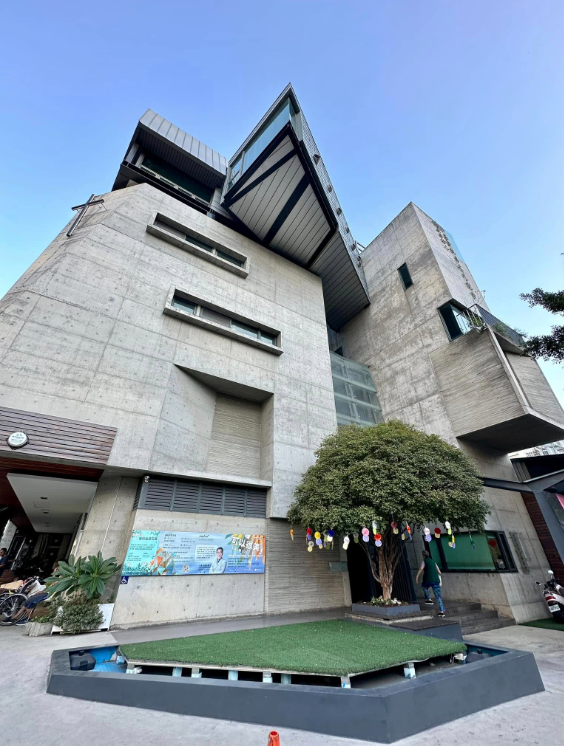
Photo courtesy of Sheng-Yu Peng.
Taiwan’s National Cultural Memory Bank describes the space in three parts: the main sanctuary as a “spiritual space,” the Pear Café as an “affective space,” and the offices, classrooms, and stairways as a “rational space.” This arrangement is worth pondering for Chinese churches: rationality, affect, and spirituality need not exclude one another but can echo within a space where the body can move and the eyes can see.4
More importantly, it is not only a “beautiful church.” The architect’s office has described the design as a “church without walls”: the ground floor minimizes barriers so that neighbors can pass through and the church can become a place to linger and converse within the life of the city.5
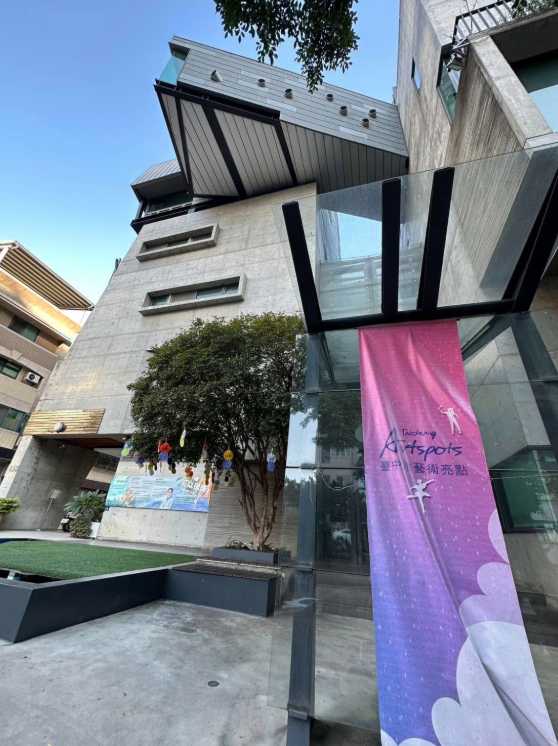
Artspots banner. Photo courtesy of Sheng-Yu Peng.
In recent years, the church has also hosted “It Can Be Beautiful” exhibitions, lectures, and workshops, linking aesthetic perception with faith formation.6
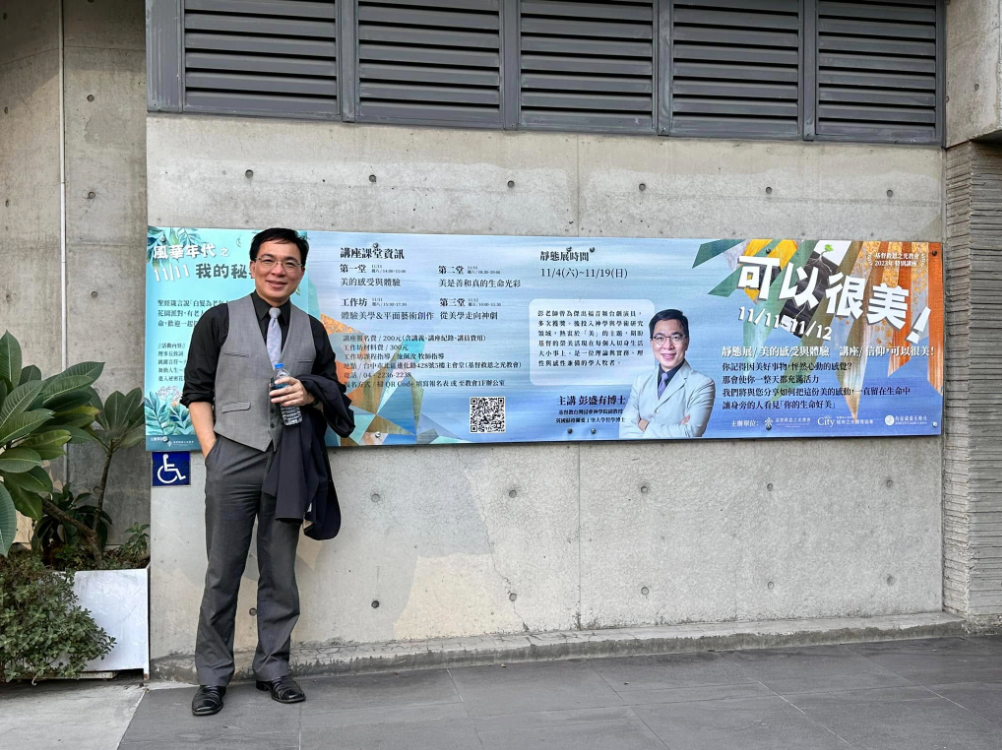
Be Beautiful” lecture series. Photo courtesy of Sheng-Yu Peng.
Here public theology has another entrance: a beam of light, a staircase, an open café, an exhibition that invites people to pause and read. The church opens itself first through space, rhythm, and hospitality; public witness thus moves from speech to presence, from being heard toward being seen. When faith can be experienced spatially, the next question is whether the church’s weekly worship likewise forms people’s eyes, ears, and hearts with such patience.
The Aesthetics of Liturgy: Returning from “Propaganda Rallies” to “Sacred Space”
Contemporary worship is deeply influenced by the entertainment industry and corporate training, and it pursues audiovisual stimulation and efficiency. Many churches have also unconsciously borrowed the rhythm of consumer culture: fast, intense, and immediately effective. The practice of public theology can begin with “silence” and “blank space” in the liturgy. Amidst information bombardment, if the church can provide a sacred space where the senses can rest, this act itself is a form of public resistance.
Through solemn liturgy and spatial aesthetics, we train believers to grow accustomed to a “sacred slowness.” Only a community that knows how to watch in silence before God can issue a voice that is carefully considered, discerning, and measured amidst clamorous issues.
The Transformation of Narrative: From “Victors’ Templates” to “The Honesty of the Wounded”
For a long time, the narratives presented by the church have mostly been singular “victors’ narratives”: peace, success, and perfection. Although these “beautified” testimonies are glamorous, they appear hypocritical because they lack a true depiction of suffering.
True aesthetic education teaches us to face brokenness honestly; one-third of the Psalms are laments. The church should learn to use artistic language to tell stories that include struggle and sighing. When the church dares to display an “Aesthetics of Brokenness” and admits that we are also wounded healers rather than moral judges, it breaks down the dividing wall. This human honesty can win the respect of public society far better than moral slogans.
Collaborating with the City: Returning Art to the Public
Future aesthetic education does not need to begin with “large-scale art ministries.” The church can first establish a community of watching and listening at a small and steady pace. It can regularly invite people to view exhibitions or films, or it can use a painting, a poem, or a piece of music as a text to practice description, questioning, and listening. It can also collaborate with local arts and cultural spaces, and it can open the church during non-gathering hours for readings, lectures, or workshops. When the church is willing to yield its space to its neighbors, publicness is no longer merely a declaration, but becomes an accessible hospitality.
Conclusion: Gentle Resistance
The public theology of the Chinese church currently faces the test of a turning point. In the past, we often used the “sword of truth” to slice through social fallacies, and we frequently wounded the possibility of dialogue. We fought for the right to speak, but we forgot that if speech is not carried by “beauty,” it ultimately becomes dry and grating.
We raise the topic of “art and aesthetic education” again to bring the church back to a more fundamental question: how do we see in public, and how are we seen? In a violent and binary era, beauty is not merely a decoration; it is also a gentle and resilient resistance entrusted to us by God. Art draws our gaze away from self-absorption and teaches us to unself. Aesthetic education brings this posture into daily life, and it makes us willing to linger and endure before complex issues. When the senses are no longer numb, justice transforms from a concept into a calling; it both stings and draws us into action.
Of course, power can also misappropriate beauty and turn it into a whitewash that conceals the truth. The beauty that Christians pursue requires calibration through the cross: it does not evade trauma, nor does it romanticize trauma. It allows light to shine into the cracks, so that people can still hope. In Fyodor Dostoevsky’s The Idiot, a character once relayed a statement with a prophetic tone: “Beauty will save the world.”7 If this phrase is treated merely as a slogan, it is certainly lightweight. When we place it back into the core of the Christian faith, however, it points to a more solemn promise: that supreme beauty is the incarnate Christ. When the Chinese church learns to see in public and to live out this beauty in daily life, the world will also begin to see and listen to us anew.
- Iris Murdoch, The Sovereignty of Good (London: Routledge & Kegan Paul, 1970), 82–84.
- Elaine Scarry, On Beauty and Being Just (Princeton, NJ: Princeton University Press, 1999), 109–12, 118–21.
- “光中與神對話:基督救恩之光教會” [In Conversation with God through Light: The Light of Christ Salvation Church]. GOOD TV 好消息國度新聞, April 11, 2017. Accessed May 11, 2026. https://goodtvnews.goodtv.tv/goodtvnews/taiwan-church2/.
- 基督救恩之光教會的階梯” [Staircase of The Light of Christ Salvation Church]. National Cultural Memory Bank. Accessed May 11, 2026. https://tcmb.culture.tw/zh-tw/detail?id=666024&indexCode=Culture_Place.
- “基督救恩之光教會” [The Light of Christ Salvation Church]. AMBi Studio 立建築師事務所. Accessed May 11, 2026. https://ambi.com.tw/project/10.
- “2023年 特別講座~主題「可以很美!」” [2023 Special Lecture—Theme: “It Can Be Beautiful!”]. OursEvents. Accessed May 11, 2026. https://event.oursweb.net/w/vlVApf38.
- Fyodor Dostoevsky, The Idiot, trans. Richard Pevear and Larissa Volokhonsky (New York: Alfred A. Knopf, 2002), 382.